Introduction
It was during one of those lazy Sunday afternoons, scrolling through news about john furner takes over walmart | charlie mcavoy, that I realized how cluttered my life had become. Not just digitally, but physically too. My wallet, bulging with loyalty cards I never used and receipts from months ago, felt like a metaphor for the unnecessary complexity I carried everywhere. I didn’t realize at the time that this moment of frustration would lead me to reconsider something as simple as how I carry my essentials, but it set me on a path toward minimalism that eventually introduced me to the Herschel Charlie Cardholder.
Real-life Context
My daily routine involves navigating between subway stations, coffee shops, and office buildings—a typical urban existence where every pocket’s contents mater. I’d been using the same leather bifold wallet for years, a gift that had served me well but had started to feel increasingly cumbersome. The bulge in my back pocket became a constant reminder of all the things I thought I needed but rarely used. On travel days, the anxiety of carrying important cards through crowded airports added another layer of stress. I found myself double-checking my pocket every few minutes, worried about pickpockets or electronic skimming devices I’d read about in travel forums. The weight of my old wallet wasn’t just physical—it represented a mental burden I hadn’t acknowledged until I started paying attention to how often I adjusted it, patted it down, or worried about its contents.
Transitioning between work and personal life meant carrying different sets of cards, and my old wallet made no distinction between what was essential and what was situational. The process of digging through multiple slots to find my transit pass during morning rush hour or my ID when entering office buildings created small but cumulative moments of frustration throughout each day. I began noticing how other people managed their carry—the front-pocket wallets, the cardholders, the minimalist approaches that seemed so much more streamlined than my own. It wasn’t about fashion as much as function, about reducing the friction between needing something and having it accessible.
The environmental aspect of my purchases had also become more important to me over time. I found myself reading labels and researching materials, wanting my consumption choices to align with broader values about sustainability. My old wallet, though durable, represented a time when I didn’t consider where products came from or what happened to them after I was done using them. This growing awareness extended to all my accessories, making me more deliberate about what I carried and why. The intersection of practicality, security, and environmental responsibility became my new criteria for everyday items—including something as seemingly simple as a wallet.
Observation
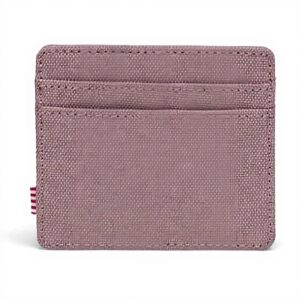
The first thing I noticed about the Herschel Charlie Cardholder was how it disappeared in my front pocket. Measuring just 0.25 x 10.16 x 7.62 cm and weighing only 33 grams, its slim profile eliminated the familiar bulge I’d grown accustomed to with my old wallet. I started with just my essential cards—ID, two credit cards, transit pass, and a bit of emergency cash—and found the multiple card slots and storage sleeve accommodated everything I actually needed for daily use. The ash rose color provided a subtle, sophisticated look that worked equally well with business attire and weekend wear, fitting the unisex design that made it versatile for any occasion.
During my first week using it, I became aware of how many times I previously reached for a wallet that wasn’t there—or rather, was there but so slim I didn’t feel it. The psychological shift was remarkable. Without the constant physical reminder of my wallet, I thought less about what I was carrying and more about where I was going. The quick-access card slots proved particularly useful during my commute, allowing me to tap my transit pass without removing the cardholder from my pocket. This small efficiency changed the rhythm of my morning routine, eliminating those frustrating moments of fumbling at turnstiles while balancing a coffee and phone.
When I traveled for a weekend conference, the RFID blocking technology provided peace of mind I hadn’t realized I needed. Passing through crowded airports and tourist areas, I remembered articles I’d read about electronic pickpocketing and felt reassured knowing my card information was protected. The integrated RFID blocking layer worked silently in the background, requiring no activation or special handling on my part. This seamless security feature exemplified the thoughtful design that went into the cardholder—protection without complexity, functionality without fuss.
The EcoSystem fabric, made from 100% recycled post-consumer water bottles, held up beautifully to daily use. Despite its lightweight construction, the material showed no signs of wear after weeks of being slipped in and out of pockets, placed on counters, and occasionally dropped in my bag. The tonal stripe EcoSystem liner added a subtle visual texture that I appreciated during those moments when the cardholder was visible—paying for coffee or showing my ID. These small design touches demonstrated that sustainability didn’t require compromising on aesthetics or durability.
Reflection
What surprised me most wasn’t how the cardholder functioned, but how it changed my relationship with what I carry. I began to question why I needed so many things in the first place. The process of selecting which cards to keep forced me to evaluate what was truly essential versus what was merely habitual. That loyalty card for a store I visited once a year? Left at home. The business cards I thought I might need someday? Scanned and stored digitally. The Charlie Cardholder became a physical boundary that encouraged more intentional choices about consumption and carrying.
I reflected on how we accumulate things gradually, almost imperceptibly, until one day we’re carrying weight we don’t need or use. The transition to a minimalist wallet felt like decluttering not just my pockets but my mindset. Each time I reached for the slim profile of the cardholder, I was reminded that enough is often simpler and more elegant than more. This realization extended beyond my wallet to other areas of my life, inspiring a broader minimalism that has since affected how I approach my workspace, my schedule, and even my digital files.
The environmental aspect of the cardholder resonated deeply with this new perspective. Knowing it was crafted from recycled materials made carrying it feel like a small daily commitment to sustainability. The EcoSystem fabric represented innovation in repurposing what already exists rather than creating new waste—a philosophy that aligned with my desire to reduce my environmental footprint in practical ways. This wasn’t about making a statement to others so much as aligning my actions with my values in something as ordinary as a wallet.
I thought about security differently too. The RFID protection initially seemed like a feature for international travelers or those in high-risk environments, but I came to appreciate it as standard protection in an increasingly digital world. Like having insurance you hope never to use, the peace of mind became valuable in itself. This reflection made me consider what other ‘invisible’ protections I might be overlooking in daily life—the small precautions that create security without complicating experience.
Conclusion
The journey from a bulging traditional wallet to the slim Herschel Charlie Cardholder taught me that sometimes the most significant improvements come from subtraction rather than addition. By carrying less, I gained more—more ease, more security, and more alignment with my values. The cardholder’s thoughtful design, from its recycled materials to its RFID protection, demonstrated how products can serve multiple purposes without compromising on any of them.
This experience has changed how I evaluate all my possessions now, asking not what they can hold but what they enable me to release. The shift to minimalism, prompted by something as simple as a wallet, has created space—both literal and figurative—for what truly matters. The Charlie Cardholder continues to be my constant companion, a quiet reminder that good design doesn’t shout about its features but whispers through its seamless integration into daily life.
What began as a practical solution to a pocket problem became a lens through which I view other consumption choices. The intersection of sustainability, security, and simplicity represents a standard I now apply more broadly, seeking products that solve problems without creating new ones. In a world of constant accumulation, the choice to carry less has paradoxically given me more—more freedom, more mindfulness, and more appreciation for designs that respect both the user and the environment.